Key facts
- Known for: Aerospace scientist; 11th President of India
- Born: 15 October 1931, Rameswaram, Tamil Nadu
- Age: 83 at death
- Died: 27 July 2015, Shillong
- Spouse: Never married
Childhood in Rameswaram
Avul Pakir Jainulabdeen Abdul Kalam was born on 15 October 1931 in Rameswaram, a temple island town in what was then the Madras Presidency and is now Tamil Nadu. He was the youngest of five siblings. His father owned and hired out boats to fishermen, and the family, once comfortably off, had fallen on harder times by Kalam's childhood. As a boy he helped the household by distributing newspapers.
Kalam later wrote warmly about the religious harmony of Rameswaram. His father, A. P. Jainulabdeen, was also an imam, and Kalam recalled how every evening his father, the head priest of the Ramanathaswamy temple and a church priest would sit together over tea and discuss the island's affairs. He also remembered teachers who encouraged his curiosity and his interest in how birds fly. He completed his schooling at Schwartz Higher Secondary School in Ramanathapuram and then studied physics at St. Joseph's College in Tiruchirappalli.
Family
Kalam was the youngest of five children. His father, Jainulabdeen Marakayar, owned boats that ferried pilgrims between Rameswaram and Dhanushkodi and served as imam of a local mosque; his mother, Ashiamma, ran the household. His eldest sibling was a sister, Asim Zohra, followed by three brothers. The eldest, Mohammed Lebbai, lived to the age of 104 and died in 2021. Kalam stayed close to his siblings and their children all his life and regularly sent them money from his salary, while remaining a lifelong bachelor.
Career milestones
- 1960
Graduates from Madras Institute of Technology
- 1969
Moves to ISRO
- 1980
SLV-III puts Rohini in orbit
- 1983
Leads the guided missile programme
- 1998
Pokhran-II tests
- 2002
Sworn in as President
Education
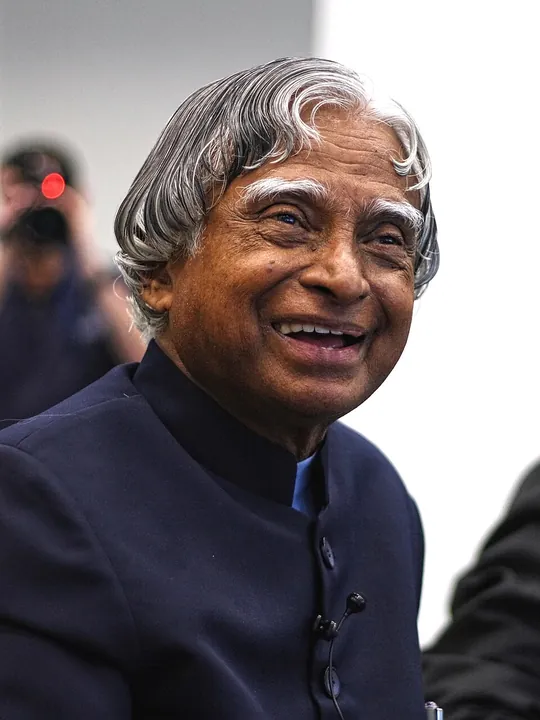
Kalam studied at Schwartz Higher Secondary School in Ramanathapuram, where he was remembered as a bright and hard-working student. He took a bachelor's degree in physics at St Joseph's College in Tiruchirappalli in 1954, and then moved to Madras in 1955 to study aeronautical engineering at the Madras Institute of Technology, graduating in 1960. He later said that missing selection as an Indian Air Force pilot, after narrowly missing one of the places available, pushed him towards research.
Training as an engineer
Kalam's real interest was flight. He moved to the Madras Institute of Technology to study aeronautical engineering, graduating in 1960. A well-known story from those years recounts how the dean, unhappy with the slow progress of Kalam's design project, threatened to withdraw his scholarship unless the work was finished within days; Kalam and his team completed it on time. He hoped to become a fighter pilot but narrowly missed selection by the Indian Air Force, an episode he described as one of the formative disappointments of his life.
DRDO and the move to ISRO
After graduating, Kalam joined the Defence Research and Development Organisation (DRDO) as a scientist at the Aeronautical Development Establishment, where he worked on a small hovercraft among other projects. In 1969 he moved to the Indian Space Research Organisation (ISRO), the organisation built up by Vikram Sarabhai.
At ISRO he became project director of the SLV-III, India's first satellite launch vehicle designed and built in the country. After an unsuccessful first flight in 1979, the SLV-III successfully placed the Rohini satellite into near-Earth orbit in July 1980. The launch made India one of a small number of nations able to put a satellite in orbit with its own rocket, and it made Kalam a nationally known figure. He continued to contribute to launch vehicle development at ISRO, including work that fed into the Polar Satellite Launch Vehicle.
The Missile Man
Kalam returned to DRDO in the early 1980s to lead the Integrated Guided Missile Development Programme, approved by the government in 1983. The programme brought several missile projects under one plan and produced, among others, the surface-to-surface Prithvi and the Agni, India's first intermediate-range ballistic missile, which drew on SLV-III technology and was first launched in 1989. These projects earned him the popular title "Missile Man of India".
From 1992 to 1999 he was scientific adviser to the defence minister and secretary of DRDO. He then served as Principal Scientific Adviser to the Government of India, with the rank of a cabinet minister, until 2001.
Pokhran-II
In May 1998 India carried out a series of nuclear tests at Pokhran in Rajasthan, known as Pokhran-II. Kalam, together with Rajagopala Chidambaram, served as chief project coordinator for the tests. The tests established India as a declared nuclear weapons state and drew international criticism and sanctions, but within India they made Kalam a national hero. The same year he put forward Technology Vision 2020, a plan describing how science and technology, from agriculture to health care and education, could help India become a developed nation within two decades.
President of India
In 2002 the governing National Democratic Alliance proposed Kalam as its candidate for President, and the main opposition party, the Indian National Congress, also supported him. He won comfortably against Lakshmi Sahgal and was sworn in as the 11th President of India on 25 July 2002.
Kalam brought an unusual informality to Rashtrapati Bhavan. He made a point of meeting students, answering letters and emails, and speaking about science and national goals in simple language. He became widely known as the "People's President". He later described signing the Office of Profit Bill as the hardest decision of his term. He served one term, leaving office in July 2007, when he was succeeded by Pratibha Patil.
Teacher and writer
After the presidency Kalam returned to what he described as his favourite role, teaching. He was a visiting professor at several Indian Institutes of Management, an honorary professor at Anna University and, from September 2007, the first chancellor of the newly established Indian Institute of Space Science and Technology in Thiruvananthapuram. He travelled constantly to address students, often asking audiences to repeat pledges about hard work and honesty.
His autobiography, Wings of Fire (1999), written with Arun Tiwari, became one of the best-selling books in India and has been translated into many languages. Ignited Minds (2002) and several other books set out his ideas about education, leadership and national development.
Career timeline
| Year | Role or milestone |
|---|---|
| 1960 | Joins the Aeronautical Development Establishment of the DRDO as a scientist |
| 1969 | Moves to ISRO; project director of SLV-3, India's first satellite launch vehicle |
| 1980 | SLV-3 places the Rohini satellite in orbit |
| 1983 | Returns to DRDO to lead the Integrated Guided Missile Development Programme (Agni, Prithvi and others) |
| 1992–1999 | Scientific Adviser to the Defence Minister and Secretary, DRDO |
| 1998 | Key technical role in the Pokhran-II nuclear tests |
| 1999–2001 | Principal Scientific Adviser to the Government of India |
| 2002–2007 | 11th President of India |
| 2007–2015 | Visiting professor at institutions including IIM Shillong, IIM Ahmedabad and IISc |
Books
His autobiography Wings of Fire (1999), written with Arun Tiwari, became one of India's best-selling non-fiction books. Other titles include India 2020 (1998, with Y. S. Rajan), Ignited Minds (2002), and Transcendence (2015), about his spiritual mentor Pramukh Swami. He wrote with the aim of inspiring students and young professionals, and his books have been translated into many Indian and foreign languages.
Death
On 27 July 2015 Kalam collapsed while delivering a lecture at the Indian Institute of Management Shillong and was declared dead of a cardiac arrest soon afterwards. He was 83. He was laid to rest at Pei Karumbu in Rameswaram, and a national memorial was inaugurated near his home town in 2017. Kalam never married.
Honours
Kalam received the Padma Bhushan in 1981, the Padma Vibhushan in 1990 and the Bharat Ratna, India's highest civilian honour, in 1997. Many institutions and places bear his name. In 2015 Wheeler Island, the missile test site off Odisha, was renamed Abdul Kalam Island, and in 2017 a bacterium discovered on the International Space Station was named Solibacillus kalamii in his honour.
| Year | Honour |
|---|---|
| 1981 | Padma Bhushan |
| 1990 | Padma Vibhushan |
| 1997 | Bharat Ratna |
| 1997 | Indira Gandhi Award for National Integration |
| 2007 | King Charles II Medal, Royal Society (UK) |
| 2009 | Hoover Medal (ASME Foundation, US) |
He also received honorary doctorates from more than 40 universities in India and abroad.
Legacy
Kalam's life combined two stories that resonate strongly in India: the rise of a boy from a modest background through education, and the growth of the country's scientific and technological capability. His work on rockets and missiles remains debated in strategic terms, but his personal reputation for simplicity, integrity and devotion to students is almost universally admired. His sayings about dreams and hard work are among the most quoted in Indian classrooms.
Frequently asked questions
How old was A. P. J. Abdul Kalam when he died?
He was born on 15 October 1931 and died on 27 July 2015, aged 83.
What is A. P. J. Abdul Kalam's full name?
Avul Pakir Jainulabdeen Abdul Kalam.
Was A. P. J. Abdul Kalam married?
No. He never married and had no children.
Who were A. P. J. Abdul Kalam's parents?
Jainulabdeen Marakayar, a boat owner and imam in Rameswaram, and Ashiamma, a homemaker.
How many siblings did Abdul Kalam have?
Four: an elder sister, Asim Zohra, and three elder brothers. He was the youngest of five.
Where did Abdul Kalam study?
At Schwartz Higher Secondary School in Ramanathapuram, St Joseph's College in Tiruchirappalli (physics) and the Madras Institute of Technology (aeronautical engineering).
Why is Abdul Kalam called the Missile Man of India?
Because he led India's Integrated Guided Missile Development Programme from 1983, which developed missiles including Agni and Prithvi.
When was Abdul Kalam President of India?
From 25 July 2002 to 25 July 2007, as the 11th President.
How did Abdul Kalam die?
He collapsed from a cardiac arrest while giving a lecture at IIM Shillong on 27 July 2015.
Where is Abdul Kalam buried?
In his hometown, Rameswaram, where the Dr. A. P. J. Abdul Kalam National Memorial was opened in 2017.
What books did Abdul Kalam write?
His best-known books are Wings of Fire (1999), India 2020 (1998) and Ignited Minds (2002).
When did Abdul Kalam receive the Bharat Ratna?
In 1997, five years before he became President.
Sources
- Encyclopaedia Britannica: A.P.J. Abdul Kalam
- Wikipedia: A. P. J. Abdul Kalam (cross-checked dates)
- Press Information Bureau: Dr. A. P. J. Abdul Kalam National Memorial, Rameswaram (2017)