Key facts
- Known for: Industrialist; philanthropist; chairman of Tata Sons
- Born: 28 December 1937, Bombay (now Mumbai), Maharashtra
- Age: 86 at death
- Died: 9 October 2024, Mumbai
- Spouse: Never married
- Net worth: ₹3,800 crore at the time (IIFL Wealth Hurun India Rich List 2022); most of his wealth sat with the Tata Trusts
Family background
Ratan Naval Tata was born on 28 December 1937 in Bombay, now Mumbai, into one of India's best-known business families. His great-grandfather Jamsetji Tata founded the Tata Group in 1868, and the group's companies, including Tata Steel, played a central role in building Indian industry. Ratan's father, Naval Tata, had been adopted into the family by Ratanji Tata, a son of Jamsetji. The Tatas belong to the Parsi community, followers of the Zoroastrian faith known for their tradition of public service and philanthropy.
When Ratan was ten, in 1948, his parents separated. He and his younger brother Jimmy were brought up by their grandmother, Navajbai Tata, the widow of Ratanji. He also had a half-brother, Noel Tata, from his father's second marriage.
Parents and siblings
Ratan Tata was the son of Naval Tata, who had been adopted into the Tata family by Navajbai Tata, the widow of Ratanji Tata, and Sooni Commissariat. After his parents separated in 1948, he and his younger brother, Jimmy, were raised by their grandmother Navajbai at the family home in Bombay. His father later married Simone Dunoyer, and their son, Noel Tata, became chairman of Tata Trusts after Ratan's death in October 2024. His mother's second marriage gave him two half-sisters, Shireen and Deanna Jejeebhoy. Jimmy Tata, who never married, lived quietly in Mumbai.
Career milestones
- 1962
Joins Tata Group at Tata Steel
- 1991
Becomes chairman of Tata Sons
- 2000
Tata Tea acquires Tetley
- 2007
Tata Steel acquires Corus
- 2008
Jaguar Land Rover; Nano unveiled
- 2012
Retires as chairman
Education
After schooling in Bombay, Tata completed high school at the Riverdale Country School in New York City in 1955. He went on to Cornell University, where he graduated with a bachelor's degree in architecture in 1962. He then returned to India to join the family business rather than practise architecture. Much later, in 1975, he attended the Advanced Management Program at Harvard Business School.
Learning on the shop floor
Tata joined the group in 1962 and began, by design, at the bottom: working on the shop floor of Tata Steel alongside other workers. Over the following years he moved through several group businesses. In 1971 he was put in charge of the National Radio and Electronics Company (NELCO), a struggling consumer electronics firm. He worked to turn it around, but it was hit hard by an economic slowdown, a setback he later described as a valuable lesson. He became chairman of Tata Industries about a decade later.
Succeeding J. R. D. Tata
In 1991 J. R. D. Tata, who had led the group for more than half a century, stepped down and named Ratan as his successor as chairman of Tata Sons. The timing was significant: 1991 was also the year India began opening its economy. Tata's appointment met resistance from powerful heads of individual Tata companies who had run them with considerable independence. He consolidated control by introducing a retirement age for directors, changing reporting lines and bringing the companies closer to the parent.
Going global
Under Ratan Tata the group set out to become an international business rather than a largely domestic one. In 2000 Tata Tea acquired the British tea company Tetley, one of the largest overseas acquisitions by an Indian company at the time. In 2004 Tata Motors bought the truck business of South Korea's Daewoo. In 2007 Tata Steel acquired the Anglo-Dutch steelmaker Corus for about $11.3 billion, which Britannica describes as the biggest takeover by an Indian company. In 2008 Tata Motors bought Jaguar and Land Rover from Ford for about $2.3 billion. By the end of his tenure, a majority of the group's revenue came from outside India, and the group was far more reliant on brands than on commodity sales.
The software arm, Tata Consultancy Services, also grew rapidly in this period and became one of the most valuable companies in the group.
Indica and Nano
Tata had a particular interest in cars. Tata Motors' Indica, launched in the late 1990s, was among the first passenger cars designed largely in India. He then championed the Tata Nano, unveiled in 2008 as a "people's car" meant to give families who rode on scooters a safer, affordable alternative. It went on sale in 2009 at a starting price of about 100,000 rupees.
The project ran into difficulty. A planned factory at Singur in West Bengal faced fierce protests over land acquisition, and production was moved to Sanand in Gujarat. The low price proved hard to sustain, and sales were disappointing, though Tata Motors continued making the car for about a decade.
Retirement and the Mistry dispute
Ratan Tata retired as chairman in December 2012 and was succeeded by Cyrus Mistry. In October 2016 the board removed Mistry, and Tata returned as interim chairman for several months, a period of public legal and corporate dispute. Natarajan Chandrasekaran was named chairman in January 2017 and took over the following month.
Philanthropy and investing
Tata remained chairman of the Tata Trusts, the charitable trusts that hold a majority stake in Tata Sons. Through them and the group companies he supported causes including cancer care, education, rural development and research. Gifts associated with him include a $50 million donation to Cornell, then the largest by an international donor, a $50 million gift to Harvard for the executive education centre now called Tata Hall, and support for a genetics institute at the University of California, San Diego. In 2007 the Tata family received the Carnegie Medal of Philanthropy.
In retirement he also became an active personal investor in Indian start-ups, including early stakes in companies such as Ola. In 2021, the Tata Group won the bid to take back Air India, the airline founded by J. R. D. Tata and nationalised in 1953; Ratan Tata said J. R. D. would have been overjoyed.
Net worth and the Tata Trusts
Ratan Tata was never one of India's richest people by personal wealth, because most of the Tata family's holding in Tata Sons belongs to the charitable Tata Trusts rather than to individuals. The IIFL Wealth Hurun India Rich List 2022 estimated his personal net worth at ₹3,800 crore, ranking him 421st. After his death, his will was reported to leave the bulk of his estate to charitable causes, with bequests to family members, staff and the care of his dog, Tito.
Career timeline
| Year | Milestone |
|---|---|
| 1962 | Joins the Tata Group, working on the shop floor at Tata Steel in Jamshedpur |
| 1971 | Director-in-charge of National Radio and Electronics (NELCO) |
| 1991 | Succeeds J. R. D. Tata as chairman of Tata Sons |
| 1998 | Tata Indica launched, India's first indigenously designed passenger car |
| 2000 | Tata Tea acquires Tetley |
| 2007 | Tata Steel acquires Corus |
| 2008 | Tata Motors acquires Jaguar Land Rover; Tata Nano unveiled |
| 2012 | Retires as chairman; becomes chairman emeritus |
| 2016–2017 | Interim chairman after Cyrus Mistry's removal |
| 2024 | Dies in Mumbai, 9 October |
Love of animals
Tata was known for his affection for dogs. Stray dogs were allowed to shelter at Bombay House, the group's Mumbai headquarters, and one of his final projects was a 24-hour small-animal hospital in Mumbai, which opened in 2024.
Personal life and death
Ratan Tata never married and had no children. In 2011 he said he had come close to marrying four times. He died in Mumbai on 9 October 2024, aged 86, after a brief hospitalisation for age-related ailments. He was succeeded as chairman of Tata Trusts by his half-brother Noel Tata.
Honours
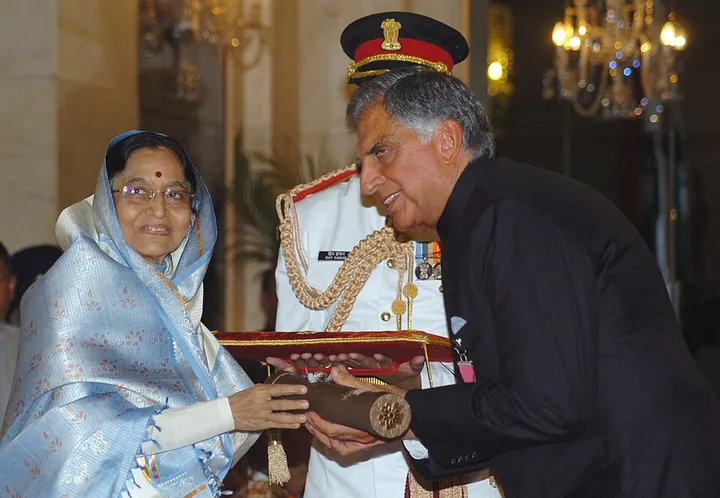
India awarded him the Padma Bhushan in 2000 and the Padma Vibhushan in 2008. Foreign honours included an honorary knighthood (KBE, 2009) and later the GBE (2014) from the United Kingdom, the Grand Cordon of the Order of the Rising Sun from Japan (2012), France's Legion of Honour (2016) and an honorary appointment to the Order of Australia (2023).
| Year | Honour |
|---|---|
| 2000 | Padma Bhushan |
| 2008 | Padma Vibhushan |
| 2008 | Honorary Citizen of Singapore |
| 2009 | Honorary Knight Commander of the Order of the British Empire (KBE) |
| 2014 | Honorary Knight Grand Cross of the Order of the British Empire (GBE) |
| 2016 | Commander of the Legion of Honour (France) |
| 2021 | Assam Baibhav |
| 2023 | Honorary Officer of the Order of Australia; Maharashtra's first Udyog Ratna |
Legacy
Ratan Tata is remembered for transforming the Tata Group from a loose collection of Indian companies into a global business, and for doing so while keeping a reputation for integrity and modesty. Many Indians admired him less for the size of his deals than for his personal conduct, his philanthropy and his open affection for ordinary people and animals.
Frequently asked questions
How old was Ratan Tata when he died?
He was born on 28 December 1937 and died on 9 October 2024, aged 86.
What was Ratan Tata's net worth?
The IIFL Wealth Hurun India Rich List 2022 estimated his personal net worth at ₹3,800 crore. Most of the Tata stake he oversaw belongs to the charitable Tata Trusts, not to him personally.
Was Ratan Tata married?
No. He never married and had no children, though he said he came close to marrying four times.
Who were Ratan Tata's parents?
Naval Tata and Sooni Commissariat. They separated when he was ten, and he was raised by his grandmother Navajbai Tata.
Who are Ratan Tata's siblings?
His brother Jimmy Tata, his half-brother Noel Tata, and his half-sisters Shireen and Deanna Jejeebhoy.
Where did Ratan Tata study?
At Cathedral and John Connon School in Mumbai, Riverdale Country School in New York, Cornell University (architecture, 1962) and Harvard Business School's Advanced Management Program (1975).
Who succeeded Ratan Tata?
Cyrus Mistry succeeded him as Tata Sons chairman in 2012; N. Chandrasekaran has held the post since 2017. Noel Tata became chairman of Tata Trusts after Ratan Tata's death.
What companies did Ratan Tata acquire?
Under his leadership the group bought Tetley (2000), Corus (2007) and Jaguar Land Rover (2008), among others.
How did Ratan Tata die?
He died at Breach Candy Hospital in Mumbai on 9 October 2024 after a brief illness, and was cremated with state honours.
Where did Ratan Tata live?
In Colaba, south Mumbai, where he lived in a seaside home and was often seen with his dogs.
What awards did Ratan Tata receive?
India's Padma Bhushan (2000) and Padma Vibhushan (2008), honorary British knighthoods (KBE 2009, GBE 2014) and France's Legion of Honour, among others.
Sources
- Encyclopaedia Britannica: Ratan Tata
- Wikipedia: Ratan Tata (cross-checked dates)
- Mint: Ratan Tata's net worth (Hurun 2022)