Key facts
- Known for: Composer, record producer, singer-songwriter
- Born: 6 January 1967, Madras (now Chennai), Tamil Nadu
- Age: 59 years (as of 8 November 2026)
- Spouse: Saira Banu (m. 1995; separated 2024)
Childhood in Madras
A. R. Rahman was born A. S. Dileep Kumar on 6 January 1967 in Madras, now Chennai, into a Tamil family. His father, R. K. Sekhar, was a composer and conductor who arranged and scored music for Malayalam films. Dileep began learning the piano at the age of four and spent much of his childhood around studios, instruments and working musicians.
When he was nine his father died. The family's finances became precarious, and renting out his father's musical equipment became the household's main source of income. He was raised by his mother, Kareema, born Kashturi. Within a few years the boy himself was playing keyboards professionally to support his mother and sisters. The pressure of work meant that he dropped out of regular schooling.
Session musician and student
As a teenager Dileep played keyboards for many of the leading composers of South Indian film music, including M. S. Viswanathan, Ramesh Naidu and Ilaiyaraaja, for whose orchestra he played on a large number of films. He also accompanied musicians such as Zakir Hussain, Kunnakudi Vaidyanathan and L. Shankar on world tours. This work exposed him to an enormous range of styles, from Carnatic music to Western pop and electronic production.
He won a scholarship to the Trinity College of Music in London and obtained a qualification in Western classical music through Trinity's programme. Synthesisers and studio technology fascinated him, and he became known for his skill with electronic sound.
Career milestones
- 1976
Father R. K. Sekhar dies
- 1992
Debut score for Roja
- 1997
Vande Mataram album
- 2001
Scores Lagaan
- 2009
Two Oscars for Slumdog Millionaire
- 2010
Two Grammys; Padma Bhushan
Education
Rahman attended Padma Seshadri Bala Bhavan in Chennai and later Madras Christian College Higher Secondary School, but his schooling was repeatedly interrupted because he had to work as a keyboard player to support his family after his father's death. He has said he dropped out of formal school as a teenager.
His formal musical training came from several directions: Carnatic and Hindustani lessons in Chennai, years of studio work for composers such as Ilaiyaraaja, M. S. Viswanathan and Ramesh Naidu, and a scholarship to the Trinity College of Music in London, through which he earned a qualification in Western classical music. In 2024 Trinity Laban, the conservatoire's successor, named him its Honorary President.
A new name
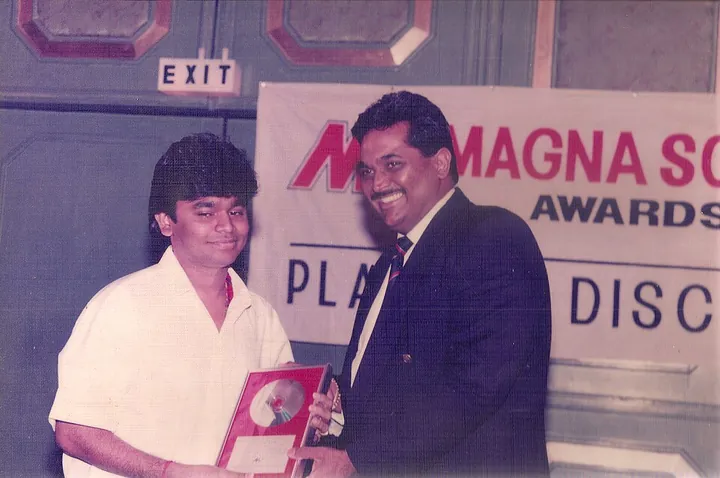
The family had been introduced to the Qadiri Sufi order in 1984, when his younger sister was seriously ill. In 1989, at the age of 23, Dileep converted to Islam together with his family. He took the name Allah Rakha Rahman, under which he would become famous. His faith has remained an important part of his life and music.
Jingles and Panchathan Record Inn
Before films, Rahman composed advertising jingles for brands and television channels. In 1987, still known as Dileep, he composed jingles for a new line of watches, and his best-known jingle, for Titan watches, which used a theme from Mozart's Symphony No. 25. Among his session work from this period was programming music for the Malayalam film Ramji Rao Speaking (1989) with the percussionist Sivamani. Around 1992 he set up Panchathan Record Inn, a recording and mixing studio built in the backyard of his home in Chennai, which would become one of the most advanced studios in India.
Roja and instant fame
In 1991, at an award ceremony for an advertising jingle, Rahman met the director Mani Ratnam, who asked him to score his next film. The result was Roja (1992). Its songs, including "Chinna Chinna Aasai", sounded unlike anything else in Indian film music, with crisp production, unusual textures and memorable melodies. The soundtrack, released in Tamil and dubbed into Hindi and other languages, was a nationwide hit and won Rahman his first National Film Award for Best Music Direction.
Rahman and Mani Ratnam went on to work together on many films, including Bombay (1995), Dil Se.. (1998), Alaipayuthey (2000), Guru (2007) and O Kadhal Kanmani (2015). He also scored hits for directors such as S. Shankar, beginning with Gentleman (1993).
Bollywood
Rahman's first Hindi film written for a Hindi audience was Ram Gopal Varma's Rangeela (1995). Dil Se.., with "Chaiyya Chaiyya", and Taal (1999) followed. For Ashutosh Gowariker's Lagaan (2001), an Oscar-nominated film set in colonial India, he wrote a score drawing on classical and folk music that is regarded as one of his best. Later Hindi work includes Rang De Basanti (2006), Jodhaa Akbar (2008), Delhi-6 (2009), Rockstar (2011) and Raanjhanaa (2013).
In 1997, for the 50th anniversary of India's independence, he released the album Vande Mataram, one of the best-selling non-film albums in India.
International work
In 2002 Rahman composed the music for Bombay Dreams, a stage musical produced by Andrew Lloyd Webber in London. He later co-wrote the music for a stage adaptation of The Lord of the Rings in Toronto and co-scored Shekhar Kapur's Elizabeth: The Golden Age (2007).
His international breakthrough came with Danny Boyle's Slumdog Millionaire (2008). His score, which captured the energy of Mumbai, won the BAFTA for best film music and the Golden Globe for best score. At the 81st Academy Awards in 2009 he won two Oscars: Best Original Score and Best Original Song for "Jai Ho", shared with the lyricist Gulzar. In 2010 he won two Grammy Awards for the soundtrack and the song. He followed it with Boyle's 127 Hours (2010), which earned two more Oscar nominations.
Recent work
Rahman has continued to work across languages and countries. His later scores include Mani Ratnam's two-part Tamil epic Ponniyin Selvan (2022–2023), the Malayalam film Aadujeevitham (2024) and the Hindi films Amar Singh Chamkila (2024) and Chhaava (2025). In 2017 he directed and wrote Le Musk, an experimental virtual-reality film.
Ramayana and what's next (as of November 2026)
Rahman's biggest current project is the music for Nitesh Tiwari's two-part Hindi epic Ramayana, which he is scoring with the Hollywood composer Hans Zimmer. The soundtrack EP, including the songs Jai Jai Ram and Ravana Tandav, was released in five languages on 21 October 2026 ahead of Part One's November 2026 release, and Rahman said in interviews that about 70 per cent of the album had been released by then. Part Two is planned for Diwali 2027. He has publicly defended the songs against mixed early reactions, saying creative work should face criticism.
Selected film scores
| Year | Film | Language | Director | Note |
|---|---|---|---|---|
| 1992 | Roja | Tamil | Mani Ratnam | Debut feature score; National Film Award |
| 1995 | Bombay | Tamil | Mani Ratnam | Best-selling soundtrack |
| 1995 | Rangeela | Hindi | Ram Gopal Varma | First original Hindi score |
| 1997 | Minsara Kanavu | Tamil | Rajiv Menon | National Film Award |
| 1998 | Dil Se.. | Hindi | Mani Ratnam | "Chaiyya Chaiyya" |
| 1999 | Taal | Hindi | Subhash Ghai | Major Hindi hit album |
| 2001 | Lagaan | Hindi | Ashutosh Gowariker | National Film Award |
| 2002 | Kannathil Muthamittal | Tamil | Mani Ratnam | National Film Award |
| 2006 | Rang De Basanti | Hindi | Rakeysh Omprakash Mehra | Youth anthem soundtrack |
| 2008 | Jodhaa Akbar | Hindi | Ashutosh Gowariker | Historical epic |
| 2008 | Slumdog Millionaire | English | Danny Boyle | Two Oscars, BAFTA, Golden Globe |
| 2010 | 127 Hours | English | Danny Boyle | Two more Oscar nominations |
| 2011 | Rockstar | Hindi | Imtiaz Ali | Critically acclaimed album |
| 2017 | Kaatru Veliyidai | Tamil | Mani Ratnam | National Film Award |
| 2022 | Ponniyin Selvan: Part I | Tamil | Mani Ratnam | National Film Award (background score) |
| 2025 | Chhaava | Hindi | Laxman Utekar | Historical drama |
Teacher and institution builder
In 2008 Rahman founded the KM Music Conservatory in Chennai to train young musicians in vocals, instruments and music technology, in both Indian and Western traditions. Its young ensemble, Qutub-E-Kripa, has been co-credited with him on background scores for films including O Kadhal Kanmani, and in 2012 its musicians toured five Indian cities with Germany's Deutsches Filmorchester Babelsberg. In December 2024 he was named Honorary President of Trinity Laban, the London conservatoire that grew out of the college where he once studied.
Personal life
Rahman married Saira Banu in 1995. They have three children: Khatija, Raheema and Ameen, two of whom also sing. In November 2024 the couple announced their separation.
Family and faith
Rahman's father, R. K. Shekhar, was a composer and arranger for Malayalam films who died in 1976, when Rahman was nine. His mother, Kareema Begum, born Kasturi, raised the family and guided his early career; she died in December 2020. His elder sister, A. R. Reihana, is a singer and composer and the mother of the composer and actor G. V. Prakash Kumar. His younger sister Fathima heads the KM Music Conservatory, and his younger sister Ishrath is also a composer.
He married Saira Banu in 1995 in an arranged marriage. Their children are Khatija, a singer and composer; Raheema; and Ameen, a playback singer. In November 2024 the couple announced their separation after 29 years of marriage. Rahman has spoken openly about his conversion to Islam with his family in 1989 and about the influence of Sufism on his life and music. He lives and works in Chennai, where his Panchathan Record Inn studio began at his home.
Net worth
CareerMasti has not found a credible published estimate of A. R. Rahman's net worth, such as a Hurun or Forbes figure, so we do not give one.
Honours
India awarded Rahman the Padma Shri in 2000 and the Padma Bhushan in 2010. He has won seven National Film Awards, two Academy Awards, two Grammy Awards, a BAFTA and a Golden Globe, along with many Filmfare awards. He is nicknamed "Isai Puyal" (musical storm) in Tamil and the "Mozart of Madras".
| Year | Award | For |
|---|---|---|
| 1993 | National Film Award for Best Music Direction | Roja |
| 1997 | National Film Award for Best Music Direction | Minsara Kanavu |
| 2000 | Padma Shri | Arts |
| 2002 | National Film Award for Best Music Direction | Lagaan |
| 2003 | National Film Award for Best Music Direction | Kannathil Muthamittal |
| 2009 | Golden Globe for Best Original Score | Slumdog Millionaire |
| 2009 | BAFTA Award for Best Film Music | Slumdog Millionaire |
| 2009 | Academy Awards for Best Original Score and Best Original Song ("Jai Ho", with Gulzar) | Slumdog Millionaire |
| 2010 | Two Grammy Awards | Slumdog Millionaire soundtrack and "Jai Ho" |
| 2010 | Padma Bhushan | Arts |
| 2018 | National Film Awards for Best Music Direction and Best Background Score | Kaatru Veliyidai; Mom |
| 2024 | National Film Award for Best Background Music | Ponniyin Selvan: Part I |
Legacy
Rahman changed the sound of Indian film music in the 1990s by combining Carnatic and Hindustani melody, Sufi devotion, folk rhythms and modern electronic production. His success took Indian film music to global stages, while his studio, conservatory and collaborations helped train a new generation of musicians.
Frequently asked questions
How old is A. R. Rahman?
A. R. Rahman was born on 6 January 1967, so he is 59 years old as of November 2026.
What is A. R. Rahman's real name?
He was born A. S. Dileep Kumar and took the name Allah Rakha Rahman when he converted to Islam with his family in 1989.
Who is A. R. Rahman's wife?
He married Saira Banu in 1995. In November 2024 the couple announced their separation.
How many children does A. R. Rahman have?
Three: Khatija, Raheema and Ameen. Khatija and Ameen are singers.
Who were A. R. Rahman's parents?
R. K. Shekhar, a composer for Malayalam films who died in 1976, and Kareema Begum (born Kasturi), who died in 2020.
Where did A. R. Rahman study music?
He trained in Indian classical music in Chennai, worked as a session musician from his teens and won a scholarship to the Trinity College of Music in London for Western classical music.
How many Oscars has A. R. Rahman won?
Two, both at the 2009 Academy Awards for Slumdog Millionaire: Best Original Score and Best Original Song for "Jai Ho", shared with lyricist Gulzar.
How many National Film Awards has A. R. Rahman won?
Seven, from Roja (1992) to Ponniyin Selvan: Part I (2022).
What religion is A. R. Rahman?
He is Muslim. He converted to Islam with his family in 1989 and has spoken about the influence of Sufism on his music.
What was A. R. Rahman's first film?
His first feature-film score was Mani Ratnam's Tamil film Roja (1992), which won him his first National Film Award.
What is A. R. Rahman working on now?
As of November 2026 he was composing for the two-part epic Ramayana with Hans Zimmer; Part One released in November 2026 and Part Two is planned for Diwali 2027.
Where does A. R. Rahman live?
In Chennai, where his studio and the KM Music Conservatory are based.
Sources
- Encyclopaedia Britannica: A.R. Rahman
- Wikipedia: A. R. Rahman (cross-checked dates and awards)
- Film Music Reporter: Ramayana soundtrack EP released (21 October 2026)
- Times of India: Rahman on reactions to the Ramayana songs
- Wikipedia: List of awards and nominations received by A. R. Rahman